BIOLOGICAL_TRANSMUTATION
fermentation
The Temporal Synthesis
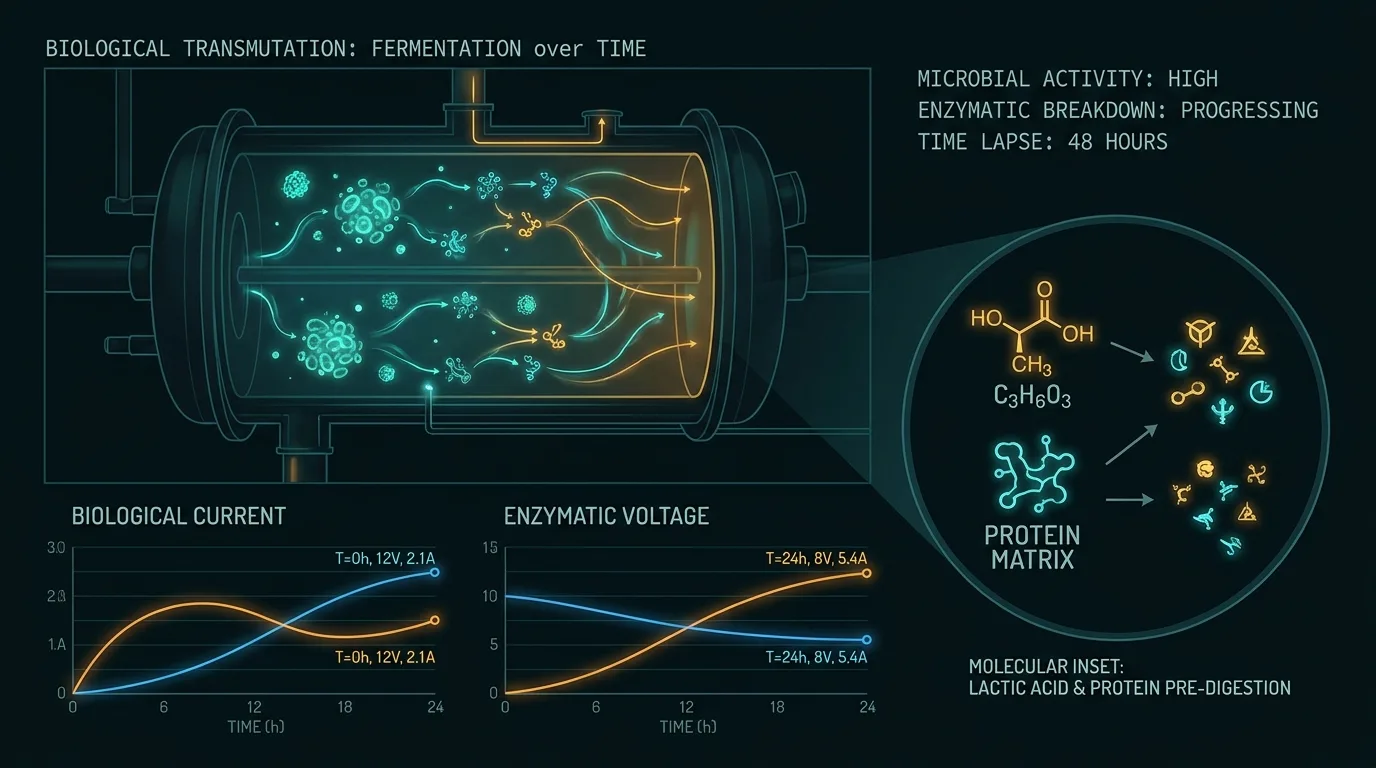
A gradual transmutation conducted by living agents. Microbial colonies metabolize the substrate over extended temporal phases, exchanging raw matter for acids, gases, and profound umami signatures.
KINETIC_PROFILE
Low-voltage biological decay and enzymatic current (I) over extended time. The transmutation occurs gradually, relying on microbial agents rather than thermal combustion.
Reaction_Rate = k[Enzyme][Substrate]ELEMENTAL_SIGNATURE
This transmutation leans water, earth & air.
ASTROLOGICAL_RULERSHIP
MOLECULAR_INTERACTION
Lactic Acid Production
The conversion of simple sugars into lactic acid via Lactobacillus activity. This creates an acidic environment hostile to putrefaction, preserving the substrate while transforming its flavor profile.
C6H12O6 → 2 CH3CHOHCOOHProtein Pre-digestion
Enzymatic cleavage of complex peptide bonds into free amino acids. This biological breakdown increases bioavailability and generates profound umami signatures.
THERMAL_ENVELOPE
Microbial activity bands vary by culture; many food ferments target cool room ranges.
PRAXIS
BENEFITS
- probiotic development
- enhanced nutrition
- natural preservation
- complex flavor development
- improved digestibility
- reduced anti-nutrients
- bioactive compound production
- extended shelf life
SUITABLE_SUBSTRATES
INSTRUMENTS
- Fermentation vessels (glass/ceramic)
- Airlocks or weights
- pH meter
- Salt/brine
- Starter cultures (optional)
- Temperature control
- Non-reactive utensils
- Digital scale (1g accuracy)
- Fermentation weights
- Cheesecloth/breathable covers
COMMON_FAILURES
- inadequate sterilization
- incorrect salt concentration
- oxygen exposure for anaerobic ferments
- improper temperature
- contamination with unwanted microbes
- inconsistent monitoring
- incorrect starter culture
- premature termination of fermentation process
EXPERT_DIRECTIVES
- For vegetable ferments, use 2% salt by weight for optimal fermentation
- Maintain temperature of 65-72°F (18-22°C) for balanced flavor development in most vegetable ferments
- For kefir, avoid metal utensils which can damage the SCOBY
- In sourdough, maintain starter at equal weights of flour and water for balanced acidity
- When making miso, ensure salt concentration is at least 5% to prevent unwanted microbes
- For kimchi, short fermentation (3-5 days) at room temperature followed by refrigeration creates balanced flavors
- Use non-chlorinated, non-distilled water for fermentation to provide necessary minerals
- For kombucha, maintain a pH between 2.5-3.5 for best flavor and safety
REGIONAL_VARIANTS
- KOREAN kimchi, gochujang, doenjang
- EUROPEAN sauerkraut, kefir, cheese
- JAPANESE miso, shoyu, natto, sake
- INDIAN dosa batter, idli, kanji
- MIDDLE EASTERN yogurt, kishk, torshi
OPTIMAL_TEMPERATURES
SAFETY_SIGILS
- pH monitoring
- Proper salt concentration
- Anaerobic environment for many ferments
- Clean equipment and workspace
- Controlled temperature
- Regular inspection for unwanted molds
ARCHIVES
HISTORICAL_RECORD
Fermentation is one of humanity's oldest food preservation methods, dating back at least 10,000 years. Every culture developed fermentation techniques, from wine and beer to bread, cheese, and preserved vegetables. It was critical for food security before refrigeration. Archaeological evidence suggests that fermented beverages predate agriculture, with fermented honey drinks (mead) possibly being one of the earliest alcoholic beverages. The scientific understanding of fermentation began with Antonie van Leeuwenhoek's microscopic observations in the 17th century, followed by Louis Pasteur's groundbreaking work in the 19th century that identified microorganisms as the agents of fermentation. The 20th century saw industrialization of many fermentation processes, while the 21st century has brought renewed interest in traditional fermentation techniques and their health benefits.
SCIENTIFIC_PRINCIPLES
- Microbial conversion of sugars to acids, alcohols, or gases
- Selective pressure through environmental conditions (saltpH, oxygen)
- Competitive inhibition of pathogenic bacteria
- Enzymatic breakdown of complex molecules
- Succession of microbial communities over time
- Production of flavor compounds through metabolic pathways
- Anaerobic vs. aerobic metabolic processes
- Substrate-specific microbial selection