NULL_TRANSMUTATION
raw
The Unfired Prima Materia
The transmutation that refuses the fire. The substrate is held in its first matter — enzymes alive, cell walls whole, color and volatile spirit intact — and where structure must change, the work is done by acid and salt rather than heat.
KINETIC_PROFILE
Zero thermal voltage is applied; the only current is the latent enzymatic activity native to the substrate. Transformation is permitted to proceed at its own un-forced rate, or arrested entirely beneath the denaturation threshold.
k = A · e^(−Ea / RT)At ambient T the rate constant k stays low — native enzymes act slowly and survive intact below ~48°C, where heat-driven denaturation would otherwise begin.
ELEMENTAL_SIGNATURE
This transmutation leans air.
ASTROLOGICAL_RULERSHIP
Mercury keeps the living enzymes quick and the matter unfixed; the Moon governs the high water content and the perishable freshness that the method exists to preserve.
MOLECULAR_INTERACTION
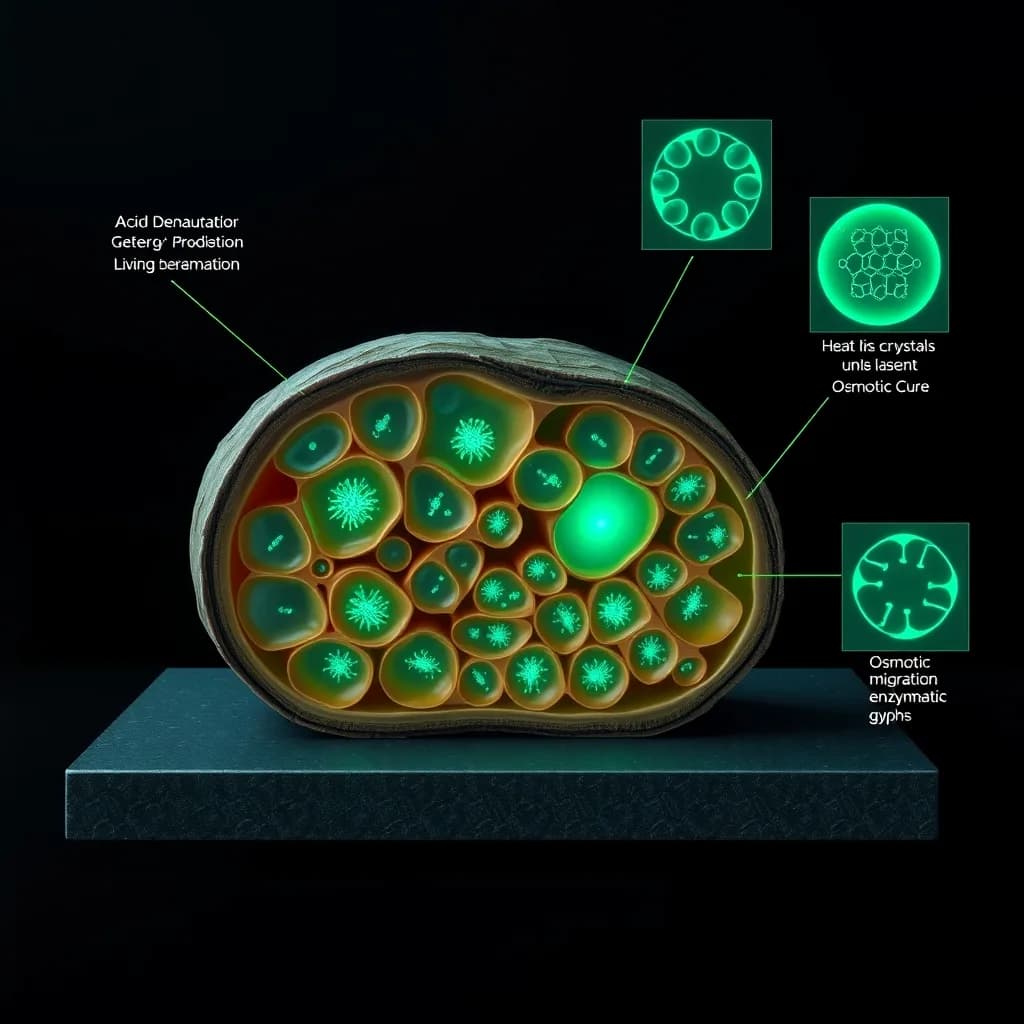
Acid Denaturation
In ceviche and crudo the heat of the fire is replaced by the heat of the proton. A flood of citric acid drops the pH past the protein's tolerance, unfolding the tertiary structure and opacifying the flesh — a cold cooking, identical in result, alien in cause.
−COO⁻ + H⁺ → −COOHEnzymatic Preservation
Below the denaturation threshold the substrate's native enzymes remain catalytically alive, carrying ripening, flavor genesis, and digestive aid forward where heat would have annihilated them.
< 48°COsmotic Cure
Salt and sugar fields draw water across the cell membrane by osmosis, firming texture and concentrating flavor without a single degree of applied heat.
- Heat-sensitive vitamins (C, B-complex) retained near maximum
- Living probiotic and enzyme cultures preserved
- Native color pigments and volatile aromatics unaltered
THERMAL_ENVELOPE
No applied heat. The range is storage and service temperature, bounded below by freezing and above by the food-safety danger zone.
PRAXIS
BENEFITS
- enzyme preservation
- maximum nutrient retention
- natural flavor preservation
- vibrant color preservation
- phytonutrient conservation
- reduced cooking energy use
- quick preparation (in many cases)
- water content preservation
SUITABLE_SUBSTRATES
INSTRUMENTS
- Sharp knives
- Food processor
- Blender
- Mandoline
- Spiralizer
- Dehydrator (optional)
- Sprouting jars
- Nut milk bags
- Cold press juicer
- Microplane/grater
COMMON_FAILURES
- inadequate food safety precautions
- poor quality ingredient selection
- improper washing techniques
- overcomplicated preparations
- ignoring seasonal availability
- insufficient flavor development
- neglecting texture considerations
- poor portion control
REGIONAL_VARIANTS
- JAPANESE sashimi, namasu, tataki
- PERUVIAN ceviche, tiradito, causa
- MEDITERRANEAN mezze platters, carpaccio, crudo
- PACIFIC poisson cru, oka i'a, kokoda
- INDIAN kachumber, mooli salads, sprouted legume preparations
OPTIMAL_TEMPERATURES
SAFETY_SIGILS
- Proper sourcing from reliable suppliers
- Thorough washing of all produce
- Separation of animal products from produce
- Temperature control below 40°F (4°C) for storage
- Regular sanitization of all preparation surfaces and tools
- Specific safety protocols for raw animal products
ARCHIVES
HISTORICAL_RECORD
The practice of eating foods in their natural, uncooked state dates back to the beginning of human existence, predating cooking technologies. Throughout history, various cultures developed sophisticated raw food preparations, from Mediterranean crudo to Polynesian poisson cru and Japanese sashimi. The modern raw food movement emerged in the 1800s with figures like Sylvester Graham advocating for unprocessed foods. Dr. Max Bircher-Benner's raw food sanitarium in the early 1900s popularized therapeutic raw eating (creating muesli in the process). The 1970s saw increased interest in "living foods" through Ann Wigmore's work. By the 1990s-2000s, raw food cuisine evolved into a sophisticated culinary approach with chefs like Matthew Kenney elevating raw preparation to fine dining. Today's approach integrates traditional knowledge with modern nutritional science and creative culinary techniques.
SCIENTIFIC_PRINCIPLES
- Enzyme preservation occurs below ~118°F (48°C) - the threshold at which most food enzymes denature
- Mechanical cell disruption through cutting/blending releases nutrients and flavors without heat
- Water-soluble vitamins (BC) remain intact without thermal degradation
- Phytochemical structures maintain biological activity without heat alteration
- Natural antioxidants remain at maximum potency without oxidative thermal stress
- Fermentation creates probiotic cultures and transforms nutrients without heat application
- Acid-based preparations (like ceviche) denature proteins through pH change rather than heat
- Salt and sugar drawing moisture through osmosis creates texture changes without cooking