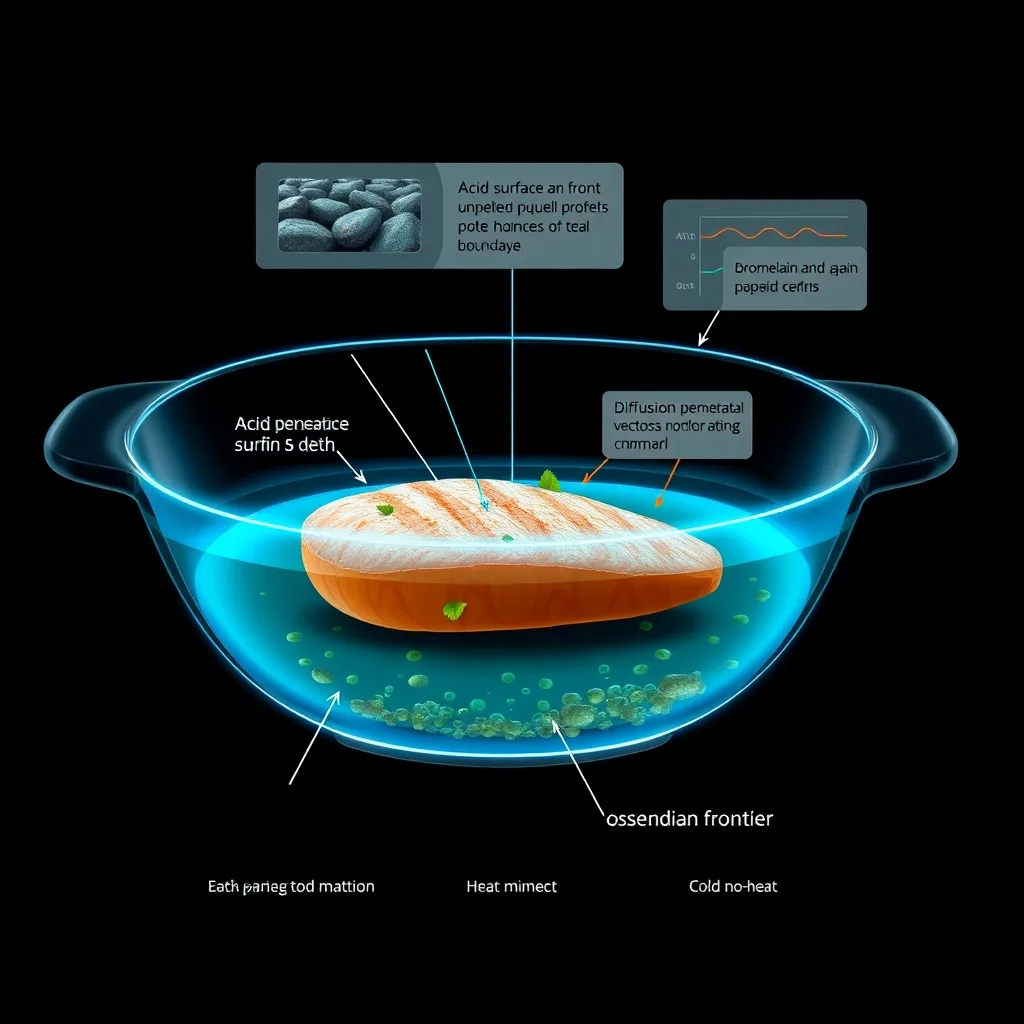
ACID_ENZYME_BAPTISM
Marinating
The Surface Communion
Immersion in an active bath of acids, enzymes, and dissolved aromatics. The marinade negotiates with the outer millimeters — denaturing, tenderizing, and seasoning the frontier before fire ever arrives.
KINETIC_PROFILE
Zero thermal voltage; the current is purely chemical. Hydrogen ions and proteolytic enzymes work the boundary layer while oil-borne aromatics queue behind them — a slow chemical siege of the surface.
x = √(2Dt)Diffusion-limited — marinade chemistry advances millimeters per hour, never to the core.
ELEMENTAL_SIGNATURE
This transmutation leans water.
ASTROLOGICAL_RULERSHIP
MOLECULAR_INTERACTION
Acid Surface Denaturation
Citrus and vinegar acids unfold surface proteins exactly as heat would — ceviche is cooking by pH. Held too long, the same chemistry turns texture mealy: acid does not know when to stop.
Proteolytic Tenderization
Bromelain, papain, and actinidin cleave peptide bonds in the outer matrix, pre-digesting the frontier. Enzymes from pineapple, papaya, and kiwi — biology lent to the knife's work.
THERMAL_ENVELOPE
Refrigerated diffusion and acid/salt-driven denaturation for safety + controlled uptake.
PRAXIS
BENEFITS
- Can infuse foods with antioxidants from herbs and spices
- Reduces formation of harmful compounds during high-heat cooking
- Tenderizes tough cuts of meat without mechanical processing
- Can reduce salt needed for flavoring
SUITABLE_SUBSTRATES
INSTRUMENTS
- Non-reactive containers (glass, ceramic, plastic)
- Resealable bags
- Whisk
- Measuring tools
- Refrigerator
- Plastic wrap
- Timer
OPTIMAL_TEMPERATURES
ARCHIVES
HISTORICAL_RECORD
Marinating has been practiced for thousands of years, originally as a preservation method using acidic liquids like vinegar or citrus juice. The technique evolved across cultures, with each developing unique marinades reflecting local ingredients and tastes.