MATRIX_BINDING
Emulsification
The Unified Matrix
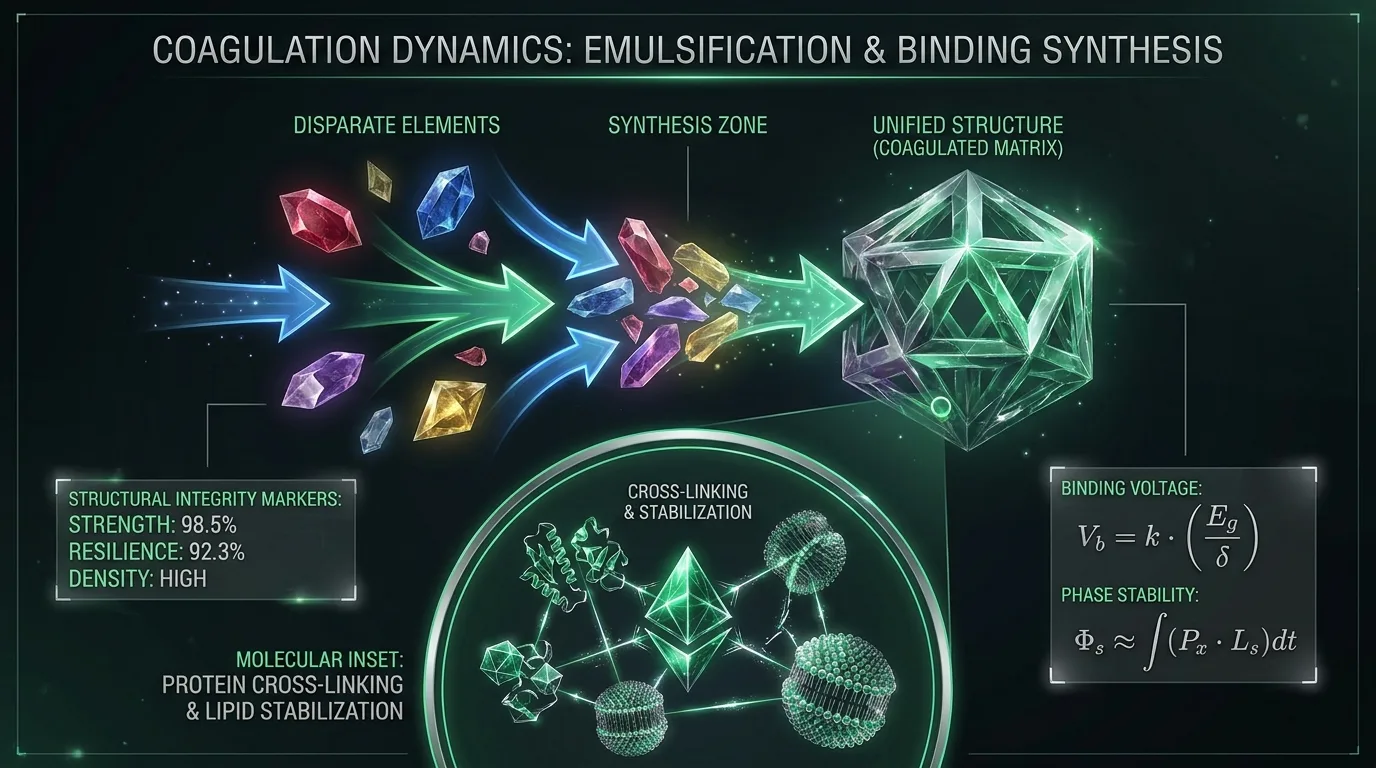
The synthesis of disparate elements into a unified structure via high-voltage binding protocols. Immiscible phases are driven into one another and held — a standing union maintained against every thermodynamic objection.
KINETIC_PROFILE
A binding voltage applied across the phase boundary sustains a steady stabilization current. The emulsion charges like a capacitor — structural order stored in the interfacial lattice, discharged only when the matrix breaks.
Binding_Energy = k · (Eg / δ)Where k = binding constant, Eg = interfacial energy gap, δ = phase boundary thickness.
ELEMENTAL_SIGNATURE
This transmutation leans water.
ASTROLOGICAL_RULERSHIP
MOLECULAR_INTERACTION
Protein Cross-Linking
The systematic alignment of denatured peptide chains, creating a stable macroscopic lattice. This structural foundation is critical for resisting thermal degradation during subsequent transmutative phases.
Lipid Stabilization
Encapsulation of hydrophobic elements within the hydrophilic matrix. The resulting emulsion exhibits anomalous resistance to phase separation, maintaining unity under extreme esoteric stress.
THERMAL_ENVELOPE
Emulsion stability is shear + temperature dependent; many systems break when overheated.
PRAXIS
BENEFITS
- Can reduce the amount of fat needed in a dish while preserving flavor
- Creates light, airy textures with concentrated flavors
- Allows for even distribution of flavor compounds
SUITABLE_SUBSTRATES
INSTRUMENTS
- Immersion blender
- Food processor
- Whisk
- Siphon/whipping canister
- Lecithin
- Soy lecithin
- Xanthan gum
- Ultrasonic homogenizer (high-end)
OPTIMAL_TEMPERATURES
ARCHIVES
HISTORICAL_RECORD
While emulsification has been used traditionally in cooking for centuries (mayonnaise, hollandaise), modern molecular gastronomy has refined the technique using scientific principles and new ingredients, popularized by chefs like Ferran Adrià and Heston Blumenthal since the 1990s.