IONIC_ENCAPSULATION
spherification
The Liquid Reliquary
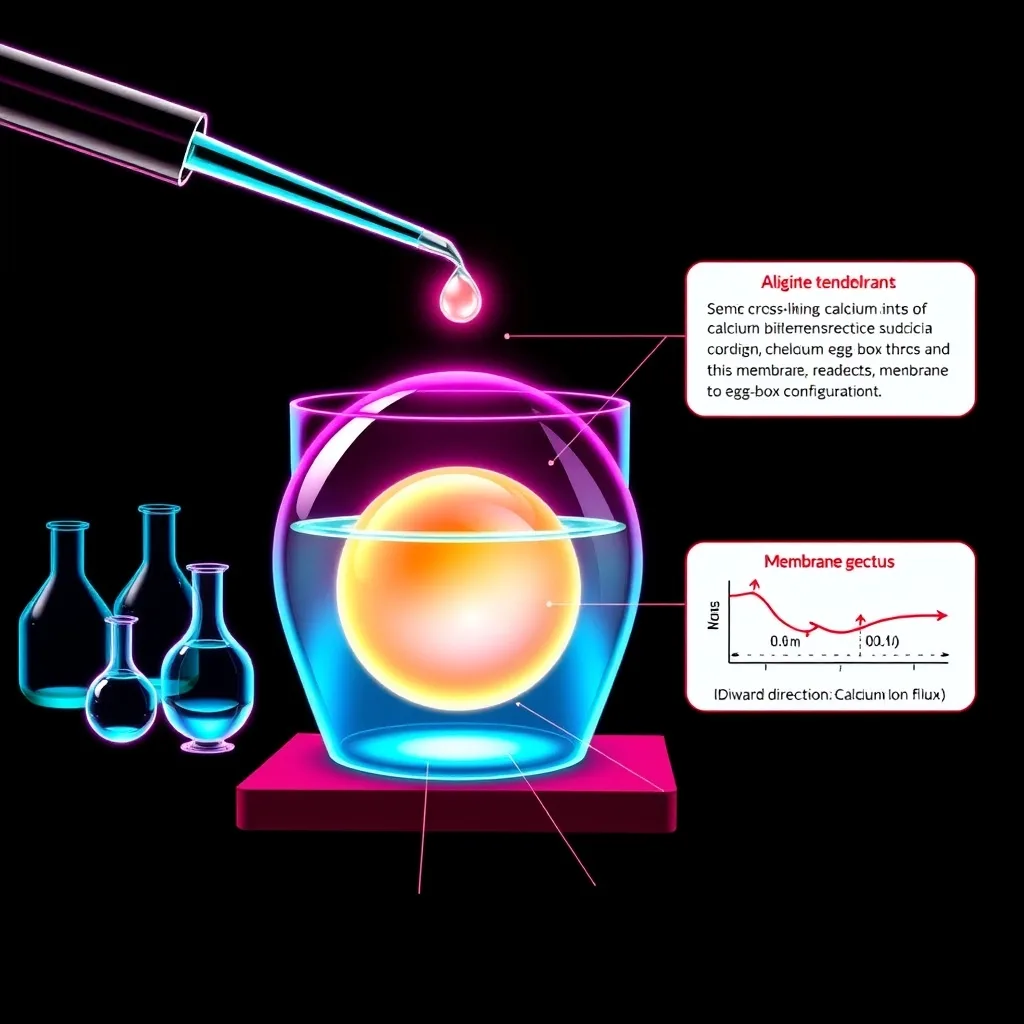
Liquid essence sealed within a self-assembling gel reliquary. Calcium ions cross-link alginate polymers at the droplet boundary, raising a semi-permeable wall around a core that remains forever liquid.
KINETIC_PROFILE
No thermal voltage is applied; the operative current is a flux of divalent calcium ions across the droplet boundary. Gelation proceeds from the outside inward, halting as the shell's own resistance chokes the ionic current.
∂C/∂t = D ∇²CFick's second law — calcium penetration governs membrane thickness, which grows with the square root of bath time.
ELEMENTAL_SIGNATURE
This transmutation leans water.
ASTROLOGICAL_RULERSHIP
MOLECULAR_INTERACTION
Ionic Cross-Linking
Divalent calcium displaces sodium along the alginate chains, zipping guluronate blocks into the egg-box configuration. The gel wall assembles only where bath meets droplet — the interior is never touched.
2 NaAlg + Ca²⁺ → Ca(Alg)₂ + 2 Na⁺Membrane Genesis
The shell thickens from the outside inward until its own bulk strangles the ion current. Timing is the whole craft: seconds separate a trembling membrane from a solid bead.
The pH Gate
Below the gate the carboxyl groups protonate and the alginate refuses to gel. Acidic essences must be buffered with citrate before they may be enclosed.
THERMAL_ENVELOPE
Hydrocolloid/calcium membrane formation works best in cool-to-room conditions.
PRAXIS
BENEFITS
- dramatic presentation
- flavor burst
- textural contrast
- precise portioning
- modern aesthetic
- controlled flavor release
- interactive dining experience
- preservation of volatile flavors
SUITABLE_SUBSTRATES
INSTRUMENTS
- Digital scale (precision to 0.1g)
- Immersion blender (for dissolving hydrocolloids)
- pH meter or pH test strips (range 2-10)
- Dropper/syringe (various sizes from 1ml to 60ml)
- Slotted spoon (fine mesh)
- Silicone hemisphere molds (for larger spheres)
- Calcium baths (wide, shallow containers)
- Vacuum chamber (for removing air bubbles)
- Calibrated pipettes (for precise dosing)
- Fine-mesh strainers
COMMON_FAILURES
- Incorrect pH balance (most liquids need pH 4.0-6.0 for optimal reaction)
- Improper alginate dissolution (creating lumps or air bubbles)
- Wrong calcium concentration (too strong creates thick membranes, too weak creates fragile spheres)
- Improper timing (too short for insufficient gelation, too long for solid spheres)
- Temperature issues (too cold slows reaction, too hot degrades hydrocolloids)
- Inadequate hydration time (alginate needs 4-24 hours for complete hydration)
- Using liquids with high calcium content for basic spherification
- Failing to strain alginate solutions before use
EXPERT_DIRECTIVES
- For perfectly clear spheres, filter all solutions through fine-mesh strainer or cheesecloth twice
- Rest alginate solutions for 24 hours in refrigerator to fully hydrate and remove air bubbles
- Use a vacuum chamber to degas alginate solutions for absolutely clear spheres
- For alcohol spherification, add 0.15% xanthan gum to prevent ingredient separation
- Create a 'wash bath' of clean water to rinse spheres after calcium bath to remove bitter taste
- For extremely thin membranes, limit bath time to 20-30 seconds with immediate washing
- Use calcium lactate gluconate instead of calcium chloride for better taste in reverse spherification
- Freeze flavored liquids in silicone molds before reverse spherification for perfect shapes
REGIONAL_VARIANTS
- SPANISH modern tapas applications, culinary foams with spheres, savory olive spheres, liquid paella spherifications
- FRENCH modernist cuisine applications, wine reductions as spheres, classical sauce spherifications
- JAPANESE modern kaiseki presentations, dashi spheres, sake pearls
- NORDIC fermented flavor spheres, smoked liquid encapsulations, foraged essence spherifications
- LATIN AMERICAN tropical fruit spheres, leche de tigre pearls, chili-infused micro-spheres
OPTIMAL_TEMPERATURES
SAFETY_SIGILS
- Use food-grade chemicals only (USP or equivalent grade)
- Proper measurement of additives (1% sodium alginate = 10g per 1L)
- Follow sanitation protocols (sterile tools and work surfaces)
- Proper labeling of all chemical solutions
- Keep spherified products refrigerated if not serving immediately
- Discard spheres after 2-4 hours at room temperature
ARCHIVES
HISTORICAL_RECORD
Spherification was pioneered by Chef Ferran Adrià at elBulli restaurant in Spain in the early 2000s, though the underlying chemical principles were known in the food industry since the 1950s. Adrià and his team refined the technique into a culinary application, first serving olive oil spheres that resembled olive shapes in 2003. The technique revolutionized molecular gastronomy and inspired a generation of chefs to explore science-based cooking techniques. Chef Adrià closed elBulli in 2011, but spherification has been adopted worldwide as a staple technique in avant-garde cuisine.
SCIENTIFIC_PRINCIPLES
- Ionic gelation between negatively charged sodium alginate and positively charged calcium ions (Ca2+)
- Formation of semi-permeable membranes through cross-linking of polymer chains
- Diffusion of calcium ions into alginate solution following concentration gradient
- Cross-linking of alginate polymer chains creates egg-box molecular structure
- Osmotic pressure equilibrium determines membrane thickness
- pH-dependent reaction kinetics (optimal in mildly acidic to neutral pH)
- Temperature affects diffusion rates and reaction speed
- Viscosity of solution affects sphere formation and shape retention