SOL_GEL_TRANSMUTATION
gelification
The Crystalline Architecture
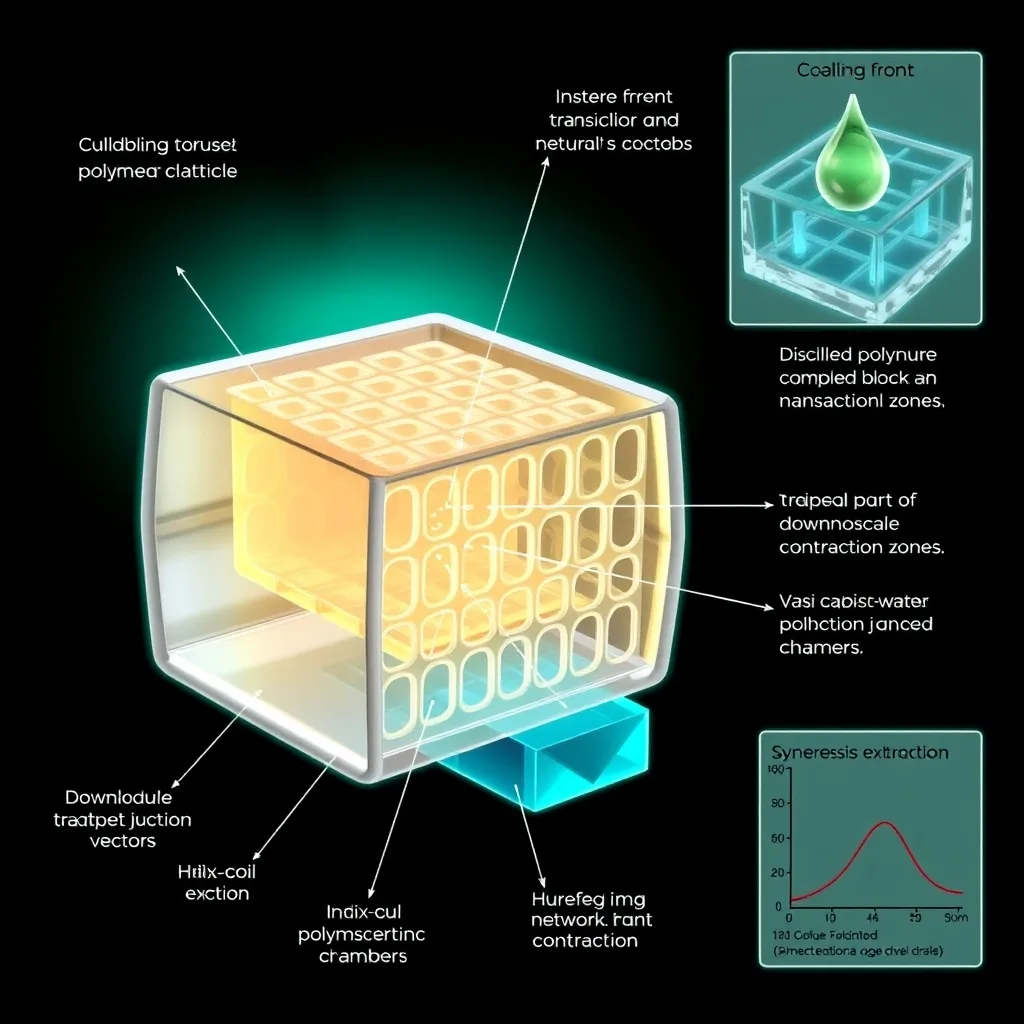
Liquid chaos disciplined into standing structure. Dissolved polymer chains cool into helices and junction zones, raising a three-dimensional scaffold that holds an ocean of water motionless.
KINETIC_PROFILE
A brief thermal voltage dissolves the lattice-to-be; as the charge bleeds away, the current condenses into structure rather than dissipating. The set gel is a capacitor of texture — energy stored as standing architecture.
p_c = 1 / (f − 1)Flory–Stockmayer criterion — the critical bond fraction at which an infinite network emerges from the sol; f = polymer functionality.
ELEMENTAL_SIGNATURE
This transmutation leans earth.
ASTROLOGICAL_RULERSHIP
MOLECULAR_INTERACTION
Junction Zone Formation
On cooling, dissolved polysaccharide coils wind into double helices that aggregate into junction zones — the rivets of the standing network. Between them, water is held captive in nanoscale chambers.
Water Imprisonment
A vanishing fraction of polymer disciplines an overwhelming mass of solvent. The architecture is almost entirely its prisoner — remove the scaffold and the structure collapses back to liquid.
Syneresis
An over-tightened lattice weeps: junction zones contract over time and expel their captive water. The architect's failure mode, countered by co-polymer synergy and exact concentration.
THERMAL_ENVELOPE
Hydration, setting, and service windows vary by hydrocolloid system (agar/gelatin/gellan).
PRAXIS
BENEFITS
- temperature-stable structures
- flavor layering
- innovative presentations
- textural contrast
- controlled release of flavors
- enhanced mouthfeel
- extended shelf life
- improved flavor stability
SUITABLE_SUBSTRATES
INSTRUMENTS
- Precision scale (0.1g accuracy)
- Immersion blender
- Water bath (temperature controlled)
- Silicon molds
- pH meter
- Thermometer
- Vacuum chamber (for removing air bubbles)
- Fine mesh strainers
- Digital refractometer (for sugar content)
- Pipettes (for precise addition)
COMMON_FAILURES
- incorrect bloom temperatures
- premature gel setting
- inadequate hydration time
- improper pH adjustment
- over-mixing causing air bubbles
- incompatible additives disrupting gel network
- incorrect concentration ratios
- failure to compensate for high acid or alcohol content
EXPERT_DIRECTIVES
- Pre-hydrate powdered hydrocolloids in cold liquids with sugar before heating to prevent clumping
- For perfect clarity in agar gels, filter hot solution through 100-micron mesh before setting
- Create broken gels by freezing, then thawing gelatin-based preparations
- Use 2: 1 ratio of locust bean gum to kappa carrageenan for elastic, cohesive textures
- For layered gels, chill each layer to 50°F before adding the next layer
- Add 0.1% calcium lactate gluconate to enhance gellan gum setting without bitter taste
- Use ultrasonic homogenization to reduce hydration time by up to 60%
- For alcoholic preparations, increase hydrocolloid concentration by 20% per 10% alcohol content
REGIONAL_VARIANTS
- FRENCH consommé gels, foie gras terrines, modern patisserie
- SPANISH el bulli-inspired spherifications, textural landscapes
- PERUVIAN tiger milk gels, ceviche reimagined
- NORDIC forest floor textures, native ingredient hydrogels
- JAPANESE wagashi-inspired transparent gels, dashi jellies, yuzu kosho gels
OPTIMAL_TEMPERATURES
SAFETY_SIGILS
- Use food-grade hydrocolloids only
- Proper measurement of additives
- Follow sanitation protocols
- Avoid contamination of gelling agents
- Maintain appropriate pH for food safety
- Monitor water activity to prevent microbial growth
ARCHIVES
HISTORICAL_RECORD
Gelification has roots in traditional cuisines (aspics, jellies), but was revolutionized in the early 2000s by Ferran Adrià and Heston Blumenthal who brought scientific precision and novel hydrocolloids to fine dining, creating previously impossible textures and presentations. The technique evolved from traditional gelatin-based preparations dating back to the 18th century French haute cuisine, where aspics and chaud-froids were symbols of culinary sophistication. The crossover between food science and high gastronomy accelerated in the 1990s with the availability of industrial hydrocolloids to chefs, and by the mid-2000s, restaurants like elBulli, The Fat Duck, and Alinea were pioneering applications that transformed dining experiences, leading to the global molecular gastronomy movement.
SCIENTIFIC_PRINCIPLES
- Hydrocolloids form three-dimensional networks that trap water
- Different gelling agents create different textures (brittle vs. elastic)
- Calcium-dependent gelation creates ionic crosslinks
- Thermal reversibility depends on gelling agent type
- Syneresis (water release) varies with polymer concentration
- pH affects gel strength and setting behavior
- Molecular weight of polymers influences gel properties
- Hydrogen bonding is temperature-dependent in most systems