CONVECTIVE_AGITATION
boiling
The Turbulent Dissolution
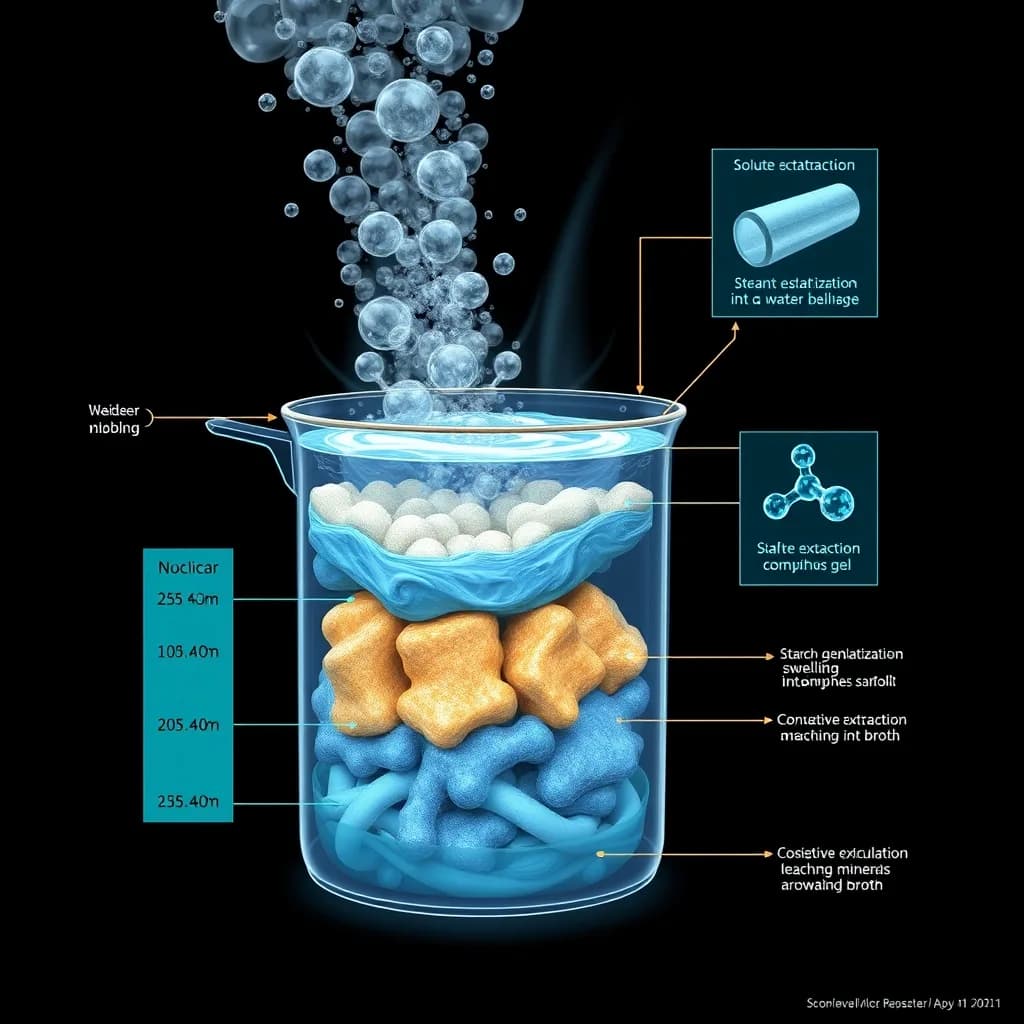
Full immersion in water driven to its phase ceiling. Nucleate vapor columns hammer the substrate in rolling turbulence, dissolving structure at maximum aqueous velocity.
KINETIC_PROFILE
Voltage is capped at the boiling point — no skill can raise it — while the current runs maximally turbulent. Vapor nucleation sites detonate continuously along the vessel floor, churning the medium into a violent convective engine.
q = h · A · (Ts − T∞)Newton's law of cooling — heat flux scales with the surface/medium differential.
ELEMENTAL_SIGNATURE
This transmutation leans water.
ASTROLOGICAL_RULERSHIP
MOLECULAR_INTERACTION
Starch Gelatinization
Above 60°C, crystalline starch granules drink the surrounding medium and swell into amorphous gels. The turbulent bath delivers water and heat simultaneously — the canonical engine for pasta, grains, and tubers.
Solute Extraction
Rolling convection strips soluble vitamins, minerals, and flavor compounds into the liquid phase. The dissolution is indiscriminate: what the substrate loses, the broth inherits — equivalent exchange in its purest culinary form.
THERMAL_ENVELOPE
Rolling boil at sea level; point shifts with altitude/pressure.
PRAXIS
BENEFITS
- quick cooking
- even heat distribution
- precise timing
- nutrient extraction into broth
- sterilization
- consistent results
- requires minimal attention
- ideal for hydrating dry ingredients
SUITABLE_SUBSTRATES
INSTRUMENTS
- Large pot or stockpot
- Heat source
- Strainer/colander
- Slotted spoon
- Timer
- Lid
- Thermometer (optional)
- Spider strainer
- Skimmer
- Wooden spoon (to prevent boil-overs)
COMMON_FAILURES
- overcooking vegetables
- insufficient water volume
- not salting pasta water
- overcrowding the pot
- boiling when simmering is better
- not using a large enough pot
- lifting lid unnecessarily (losing heat and extending cooking time)
- not accounting for altitude adjustments
REGIONAL_VARIANTS
- ITALIAN pasta al dente technique, risotto absorption method, salt concentration for pasta (as salty as the Mediterranean), double boiler for zabaglione
- ASIAN quick blanching for vegetables, hot pot cooking, noodle cooking with cold shock, controlling doneness with ice baths
- MIDDLE EASTERN rice pilaf technique, legume cooking, grain absorption methods, aromatic broths for couscous
- FRENCH blanch and shock method, court bouillon for seafood, bain-marie for delicate sauces, varying boiling temperatures for different custards
- LATIN AMERICAN corn nixtamalization, sofrito base for bean cooking, yuca and plantain preparation
OPTIMAL_TEMPERATURES
SAFETY_SIGILS
- Water boils at a consistent temperature (100°C at sea level)
- Kills most pathogens and bacteria when held at full boil for sufficient time
- Use handles and lids to prevent steam burns
- Allow proper ventilation
- Position pot handles away from edge of stove
- Use splash guards when appropriate
ARCHIVES
HISTORICAL_RECORD
Boiling is one of humanity's oldest cooking methods, dating back to the discovery of fire-resistant containers around 5000 BCE. Evidence of boiling has been found in archaeological sites worldwide, with specialized pottery for boiling developed in many cultures. The advent of pottery and the hearth revolutionized human nutrition by making grains, legumes, and tough plant materials digestible. In ancient Rome, the 'foculus' was specifically designed for boiling. Medieval cooking heavily relied on boiling, as evidenced in cookbooks like 'The Forme of Cury.' Industrial revolution brought standardized cooking equipment, and the development of pressure cooking in the 17th century by Denis Papin revolutionized boiling by raising the boiling point of water through pressure.
SCIENTIFIC_PRINCIPLES
- Water maintains consistent 100°C temperature while boiling at sea level
- Thermal energy transfer through conduction (water to food contact)
- Convection currents distribute heat evenly throughout liquid
- Pressure affects boiling point (lower at high altitudes)
- Dissolved solutes raise boiling point (colligative properties)
- Rapid protein denaturation and starch gelatinization
- Phase transition energy requirements create thermal plateau
- Evaporative cooling balances heat input at boiling point