BAROMETRIC_OVERDRIVE
Pressure Cooking
The Sealed Acceleration
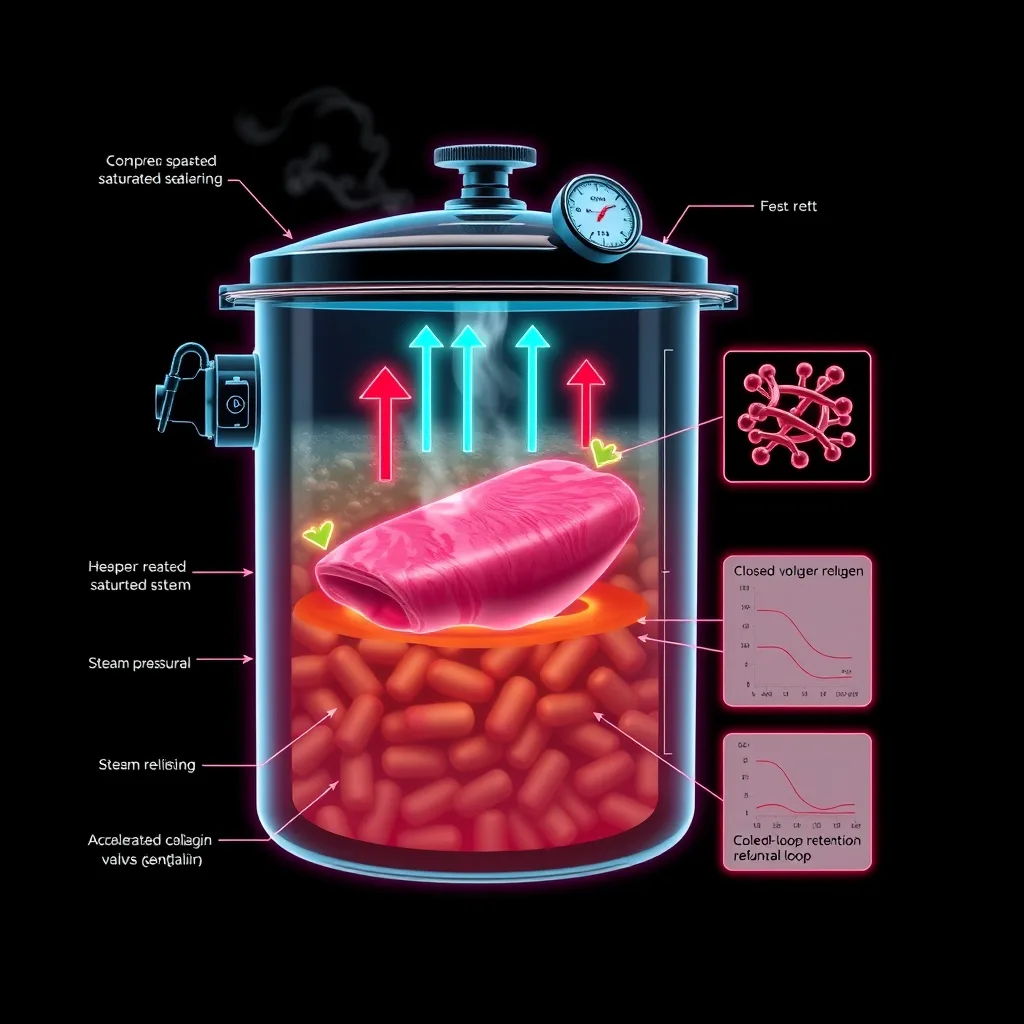
A hermetic vessel that abolishes the boiling ceiling. Pressure rewrites the phase diagram: water superheats past 120°C, and hours of transformation collapse into minutes.
KINETIC_PROFILE
The sealed field raises the attainable voltage beyond any open vessel, while saturated steam delivers current at maximum density. Every reaction obeying Arrhenius runs multiples faster inside the lock.
ln(P2/P1) = −(ΔHvap/R)(1/T2 − 1/T1)The pressure/boiling-point exchange rate — +15 psi buys ≈21°C of ceiling.
ELEMENTAL_SIGNATURE
This transmutation leans water.
ASTROLOGICAL_RULERSHIP
MOLECULAR_INTERACTION
Accelerated Collagen Hydrolysis
At 121°C the gelatin conversion that demands an afternoon at the simmer completes inside forty minutes. The superheated medium drives water into the triple helix at overdrive rates.
Closed-Loop Volatile Retention
Nothing escapes the lock. Aromatics that an open pot exhales are condensed and returned, cycling through the substrate in a sealed distillation of its own essence.
THERMAL_ENVELOPE
Elevated boiling point from sealed steam pressure; rapid collagen/starch conversion.
PRAXIS
BENEFITS
- Preserves more nutrients due to shorter cooking times
- Requires less fat for flavor development
- Breaks down lectins in beans, making them more digestible
- Enables cooking without added sodium or preservatives
- Tenderizes tough cuts of meat without excessive fat
SUITABLE_SUBSTRATES
INSTRUMENTS
- Pressure cooker
- Pressure release valve
- Heat source
- Trivet or steamer basket
- Timer
- Silicone spatula (for non-scratching)
OPTIMAL_TEMPERATURES
ARCHIVES
HISTORICAL_RECORD
Pressure cooking dates back to the 1600s when French physicist Denis Papin invented the 'steam digester,' an early pressure cooker. The modern pressure cooker was refined in the early 20th century, with significant home adoption after World War II. Electric programmable pressure cookers like the Instant Pot have revitalized the method in the 21st century.