SUB_THERMAL_IMMERSION
poaching
The Tender Suspension
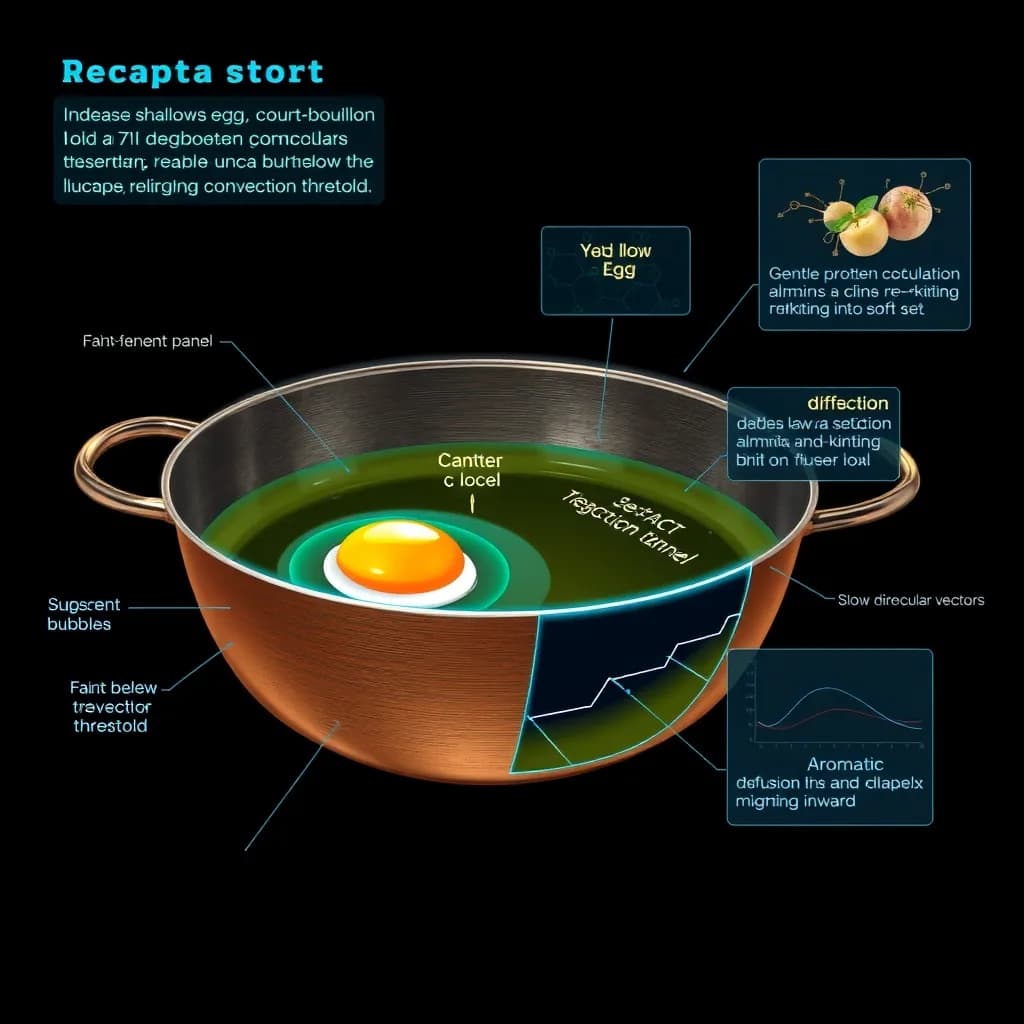
Suspension in a bath held deliberately below the boil. Proteins set in silence — no turbulence, no violence — only a barely-trembling medium coaxing structure into place.
KINETIC_PROFILE
The lowest workable voltage in the aqueous family, paired with a laminar current that never breaks into turbulence. Heat seeps rather than strikes; the substrate is persuaded, not conquered.
T_bath ∈ [71°C, 82°C]Below nucleation threshold — convection remains laminar.
ELEMENTAL_SIGNATURE
This transmutation leans water.
ASTROLOGICAL_RULERSHIP
MOLECULAR_INTERACTION
Gentle Protein Coagulation
Albumins and globulins unfold and re-knit at the precise threshold of denaturation, never tightening into rubber. The egg poached at 63°C is the proof-text: white set, yolk fluid, structure held in suspension.
Aromatic Court-Bouillon Exchange
The still medium permits deliberate seasoning of the bath itself — wine acids, mirepoix volatiles, and saline gradients migrate inward at diffusion pace, perfuming without erosion.
THERMAL_ENVELOPE
Gentle sub-simmer range to protect delicate proteins/textures.
PRAXIS
BENEFITS
- preserves delicate textures
- gentle flavor infusion
- minimizes toughening of proteins
- retains moisture
- reduces shrinkage
- preserves shape and integrity
- extracts flavor into cooking medium
- reduces risk of overcooking
SUITABLE_SUBSTRATES
INSTRUMENTS
- Wide, shallow pan with lid
- Slotted spoon or spider
- Instant-read thermometer
- Kitchen timer
- Parchment paper lid (cartouche)
- Fine mesh strainer
- Fish spatula (for delicate items)
- Poaching liquid (court bouillon, stock, wine, milk, water)
- Aromatics (herbs, spices, vegetables)
- Ladle
COMMON_FAILURES
- liquid too hot (causes toughening and shrinkage)
- liquid too cool (extends cooking time, safety concerns)
- insufficient liquid (uneven cooking)
- overcrowding the pan (temperature drops, uneven cooking)
- not using acidulated liquid for eggs (whites spread)
- boiling instead of poaching (rough texture)
- insufficient aromatics (bland result)
- not straining poaching liquid (cloudy appearance)
EXPERT_DIRECTIVES
- For perfectly poached eggs, create a vortex in acidulated water before adding egg
- When poaching fish, measure thickness and calculate 10 minutes per inch
- Always let poached meats rest before slicing to retain juices
- Save and reduce poaching liquid for natural, flavorful sauces
- Use a cartouche (parchment paper lid) to prevent surface discoloration
- The wider and shallower the poaching vessel, the more even the cooking
- For fruit, poach until just tender when pierced (avoid mushiness)
- Control poaching temperature precisely with an instant-read thermometer
REGIONAL_VARIANTS
- FRENCH poached eggs with meurette sauce (Burgundy), fish quenelles (Lyon), poule au pot (classic poached chicken), pears poached in wine (poires au vin)
- CHINESE Cantonese steamed fish (subtle poaching), white-cooked chicken (bai qie ji), rice wine poached seafood, ginger-scallion fish poaching
- ITALIAN poached seafood for insalata di mare, pesce in carpione (poached then marinated fish), white wine and herb poaching for branzino, fruit in moscato (peaches, apricots)
- NORDIC dill-poached salmon, aquavit-infused poaching liquids, cucumber poaching court bouillon, buttermilk poached cod
- JAPANESE nimono (simmered/poached dishes), sakamushi (sake-poached seafood), yudofu (hot-pot poached tofu), tamago onsen (hot spring eggs)
OPTIMAL_TEMPERATURES
SAFETY_SIGILS
- Temperature control crucial (use thermometer)
- Maintain 160°F minimum for food safety (killing pathogens)
- Keep poached items refrigerated if not serving immediately
- Use clean, fresh ingredients (especially for seafood)
- Acidulated water for eggs helps denature surface proteins (safer)
- Avoid cross-contamination between raw and poached items
ARCHIVES
HISTORICAL_RECORD
Poaching dates back to ancient times, with written records of gentle liquid cooking in Roman texts from the 1st century AD. The technique was refined in medieval European courts, particularly in France where it became a cornerstone of delicate fish cookery by the 15th century. The 17th century saw the development of court bouillon (short broth) specifically for poaching. In 19th century France, Chef Marie-Antoine Carême standardized poaching techniques and elevated them in haute cuisine, creating elaborate presentations like poached salmon in aspic. In Asian traditions, particularly Chinese cuisine, gentle poaching techniques developed independently with a focus on delicate flavors and textures, as seen in white-cut chicken (bai qie ji). Modern professional kitchens still rely on poaching as the preferred method for delicate ingredients and precision cooking.
SCIENTIFIC_PRINCIPLES
- Heat transfer primarily through convection in liquid medium
- Protein denaturation occurs gradually at 140°F-160°F without contracting/toughening
- Osmosis facilitates flavor exchange between poaching liquid and food
- Gentle temperature prevents rapid protein coagulation that causes toughening
- Constant temperature environment provides even cooking throughout food
- Water's high specific heat capacity creates stable cooking environment
- Aromatic compounds dissolve in poaching liquid creating flavor infusion
- Convection currents in liquid distribute heat evenly around food