ISOTHERMAL_PRECISION
sous vide
The Hermetic Equilibrium
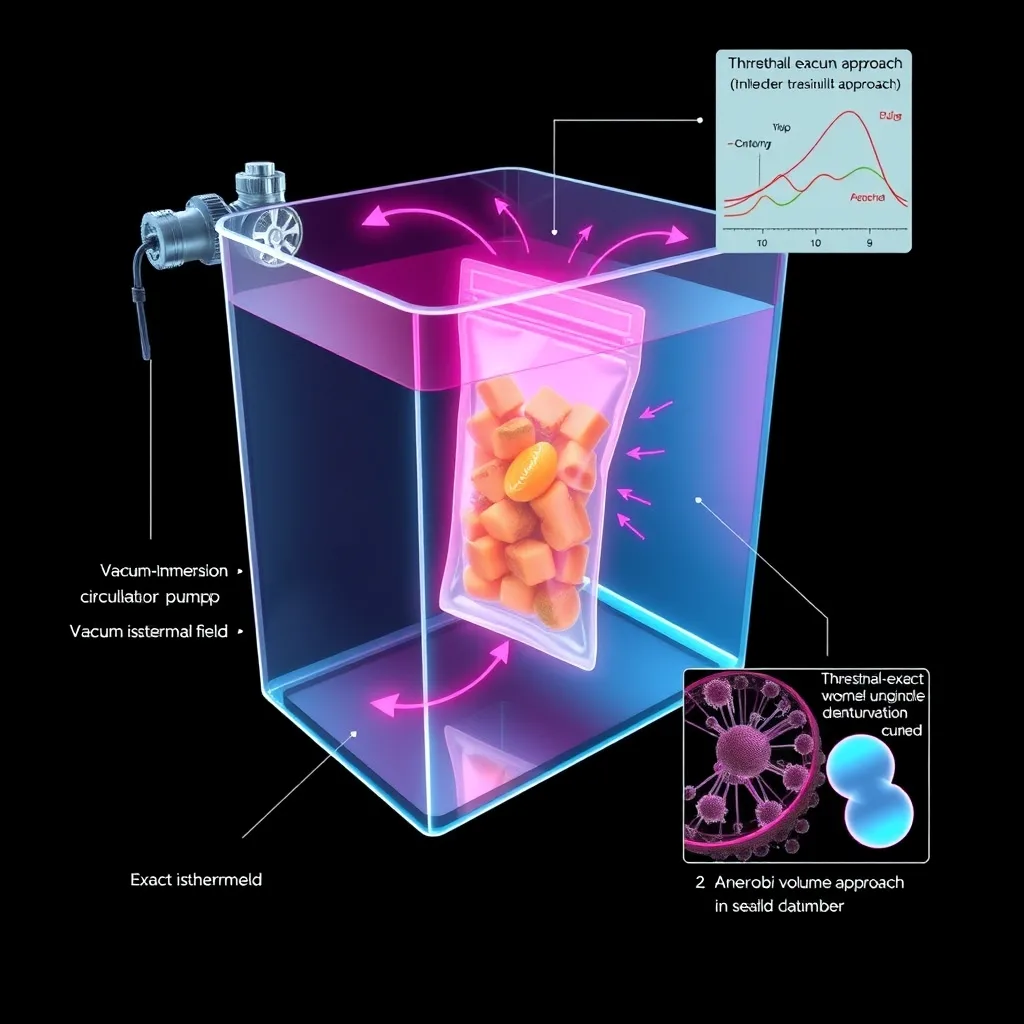
Matter sealed in vacuum and lowered into a bath that is exactly — not approximately — the target temperature. Gradient abolished, time dilated, the transformation arrives at equilibrium and simply stops.
KINETIC_PROFILE
Voltage equals the desired final state — no more — while the circulating bath supplies a perfectly conformal current through the vacuum interface. The system asymptotically approaches its setpoint and holds there indefinitely: kinetics as a controlled equilibrium rather than a race.
T_core(t) = T_bath − ΔT0 · e^(−t/τ)Exponential convergence of core temperature to the bath setpoint.
ELEMENTAL_SIGNATURE
This transmutation leans water.
ASTROLOGICAL_RULERSHIP
MOLECULAR_INTERACTION
Threshold-Exact Denaturation
Each protein has its own unfolding temperature — myosin at 50°C, actin at 66°C. The bath is set between thresholds, denaturing precisely the targets and nothing else. Edge-to-edge doneness with zero gradient.
Anaerobic Flavor Conservation
The vacuum strips the oxidative atmosphere. Volatiles cannot escape and oxygen cannot intrude — the sealed pouch becomes a closed thermodynamic system conserving every aromatic mole.
- Core/surface gradient eliminated
- Moisture loss <5% versus ~25% conventional
- Oxidative degradation nullified by vacuum
THERMAL_ENVELOPE
Precision water bath controls protein denaturation bands tightly.
PRAXIS
BENEFITS
- precise temperature control
- even cooking
- enhanced moisture retention
- consistent results
- hands-off process
- exceptional texture development
- intensified natural flavors
- time flexibility
SUITABLE_SUBSTRATES
INSTRUMENTS
- Immersion circulator
- Vacuum sealer or resealable bags
- Heat-safe food-grade bags
- Large container or pot
- Thermal immersion probe
- Timer
- Weights (to keep food submerged)
- Finishing tools (cast iron pan, torch, etc.)
- Ice bath (for quick chilling)
- Insulation for long cooks (lid, towels, etc.)
COMMON_FAILURES
- improper sealing (allowing water to enter bag)
- wrong temperature setting for desired doneness
- inadequate water circulation around bags
- overcrowding the water bath
- skipping final searing for meats
- using too small a water container
- not accounting for evaporation in long cooks
- using unsafe plastic bags not rated for heat
REGIONAL_VARIANTS
- MODERNIST precision cooking, time-temperature combinations, multi-phase cooking
- FRENCH low-temperature precision cooking, cuisine sous-vide, cuisson sous-vide
- JAPANESE onsen tamago inspiration, precision protein handling
- NORDIC long-duration game cooking, foraged ingredient preservation
- AMERICAN bbq-style long cooks, modernist home applications
OPTIMAL_TEMPERATURES
SAFETY_SIGILS
- Monitor water levels to prevent equipment damage
- Use only food-grade bags rated for cooking temperatures
- Follow pasteurization time-temperature tables for safety
- Chill rapidly if not serving immediately
- Always use fresh ingredients
- Keep bath water clean and changed regularly
ARCHIVES
HISTORICAL_RECORD
Sous vide (French for 'under vacuum') was developed in France in the 1970s by chef Georges Pralus to minimize shrinkage in foie gras. However, low-temperature cooking was first described by Benjamin Thompson (Count Rumford) in 1799. The modern technique was refined and popularized by Bruno Goussault, who established time-temperature guidelines for various foods. Sous vide remained primarily in professional kitchens until the 2010s, when affordable immersion circulators made the technique accessible to home cooks.
SCIENTIFIC_PRINCIPLES
- Thermal equilibrium - food cannot exceed water bath temperature
- Precise protein denaturation at specific temperatures
- Vacuum environment prevents oxidation and flavor loss
- Water's high specific heat provides stable cooking environment
- Slow enzymatic breakdown for tenderization
- Pasteurization through time-temperature combinations
- Conduction as primary heat transfer mechanism
- Convection currents in water ensure even temperature