INFRARED_IRRADIATION
broiling
The Inverted Sun
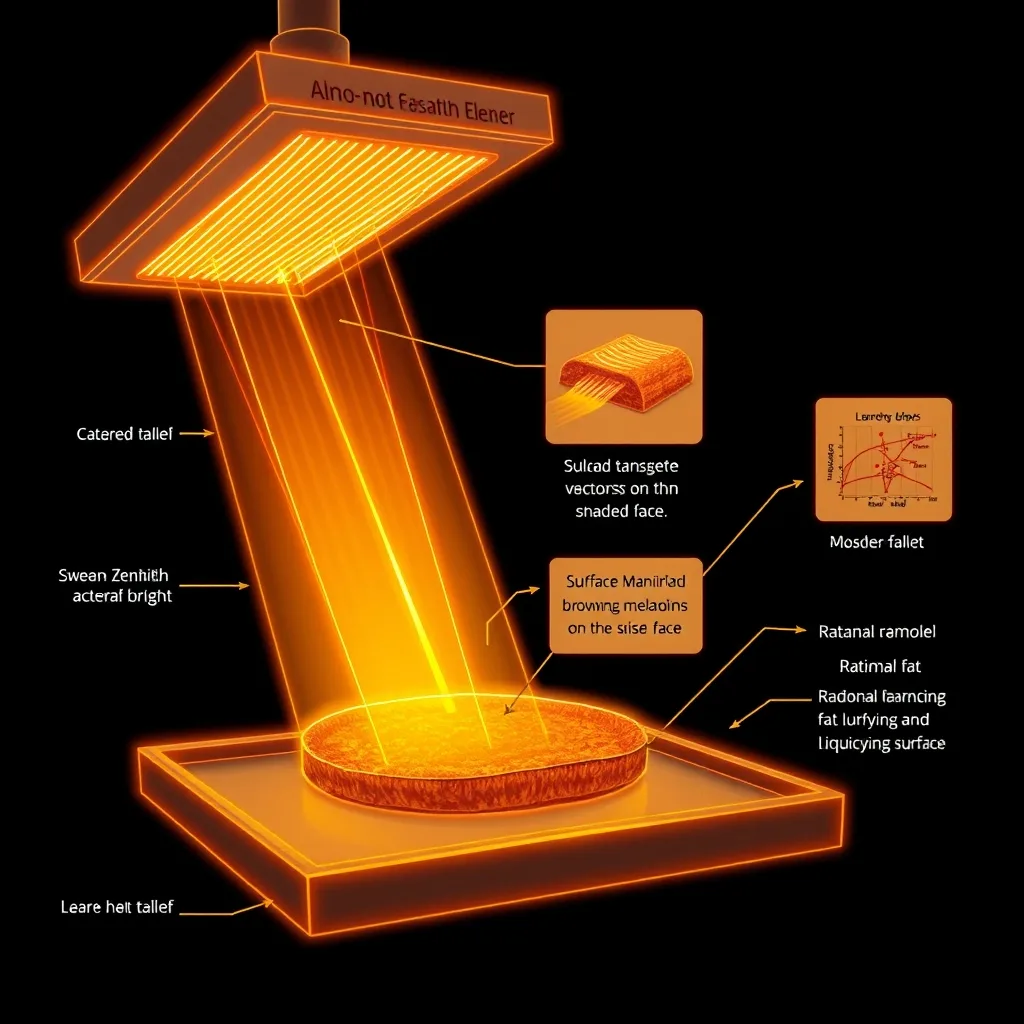
Pure radiant assault from above. An incandescent element irradiates the exposed face with infrared flux scaling to the fourth power of its temperature, searing the zenith plane while the body below remains in shadow.
KINETIC_PROFILE
Voltage is near-maximal — the element glows past 800°C — but current flows only along the line of sight; shadowed faces receive almost nothing. Distance is the resistor: flux falls off sharply with every centimeter from the element.
j* = εσT⁴Where σ = 5.67×10⁻⁸ W·m⁻²·K⁻⁴ — radiant exitance scales with the fourth power of element temperature.
q = εσA(T₁⁴ − T₂⁴)Net transfer between glowing element and substrate surface.
ELEMENTAL_SIGNATURE
This transmutation leans fire.
ASTROLOGICAL_RULERSHIP
MOLECULAR_INTERACTION
Surface Maillard Cascade
Radiant flux drives the exposed face past the browning threshold in seconds while the interior lags far behind. Amino acids and reducing sugars cascade into melanoidins across the irradiated plane only.
140°C – 180°CRadiant Fat Rendering
Surface lipids liquefy and migrate under direct infrared exposure, basting the zenith face. Rendered fat approaching its smoke point flares volatile aromatics — the signature broiler char.
Myofibrillar Contraction
Myosin and actin denature in sequence under the steep one-sided gradient, contracting the protein lattice and expelling juices if exposure outruns the thin-cut envelope.
THERMAL_ENVELOPE
Top-down radiant heat; short-distance, high-intensity finishing/cooking.
PRAXIS
BENEFITS
- creates crisp exterior
- seals in juices
- quick cooking
- browns food surface
- develops flavor
- minimal equipment needed
- melts and browns toppings
SUITABLE_SUBSTRATES
INSTRUMENTS
- Oven with broiler element
- Broiler pan or sheet pan
- Tongs or spatula
- Meat thermometer
- Oven mitts
- Timer
COMMON_FAILURES
- placing food too close to heating element
- not preheating the broiler
- overcooking
- neglecting to watch food closely
- using the wrong cookware
- broiling foods with high fat content without monitoring
- not patting food dry before broiling
EXPERT_DIRECTIVES
- Position rack 3-6 inches from heating element depending on food thickness
- Pat food dry before broiling to promote browning
- Use broiler-safe cookware (no wooden, plastic, or non-tempered glass handles)
- Preheat broiler for 5-10 minutes before cooking
- Leave oven door slightly ajar when broiling if manufacturer recommends it
- Flip food halfway through cooking for even browning
- Allow meat to rest after broiling to redistribute juices
- Apply thin layers of oil to prevent sticking and promote browning
REGIONAL_VARIANTS
- AMERICAN steakhouse broiling, lobster broiling
- ITALIAN gratinata, bruschetta finishing
- JAPANESE aburi-style sushi, miso-glazed fish
- FRENCH gratin dishes, crème brûlée finishing
- MEDITERRANEAN broiled seafood, vegetable mezze
OPTIMAL_TEMPERATURES
SAFETY_SIGILS
- Constant monitoring
- Proper distance from heat element
- Using appropriate cookware
- Temperature monitoring
- Avoiding flammable materials near broiler
- Proper ventilation
ARCHIVES
HISTORICAL_RECORD
Broiling evolved from ancient cooking methods where food was placed near open fires, but as a distinct technique with overhead heatit became refined with the development of modern ovens in the 19th century. It gained particular popularity in American steakhouses in the 20th century as a way to quickly prepare steaks with a charred exterior while maintaining a juicy interior.
SCIENTIFIC_PRINCIPLES
- Radiant heat transfer from element directly to food surface
- Infrared radiation penetrates food surface
- Maillard reaction creates complex flavor compounds
- Surface dehydration creates textural contrast
- Temperature gradient forms from exterior to interior
- Rapid protein coagulation on surface seals moisture inside
- Caramelization of sugars enhances browning and flavor
- Convection currents in the broiler compartment affect cooking rate