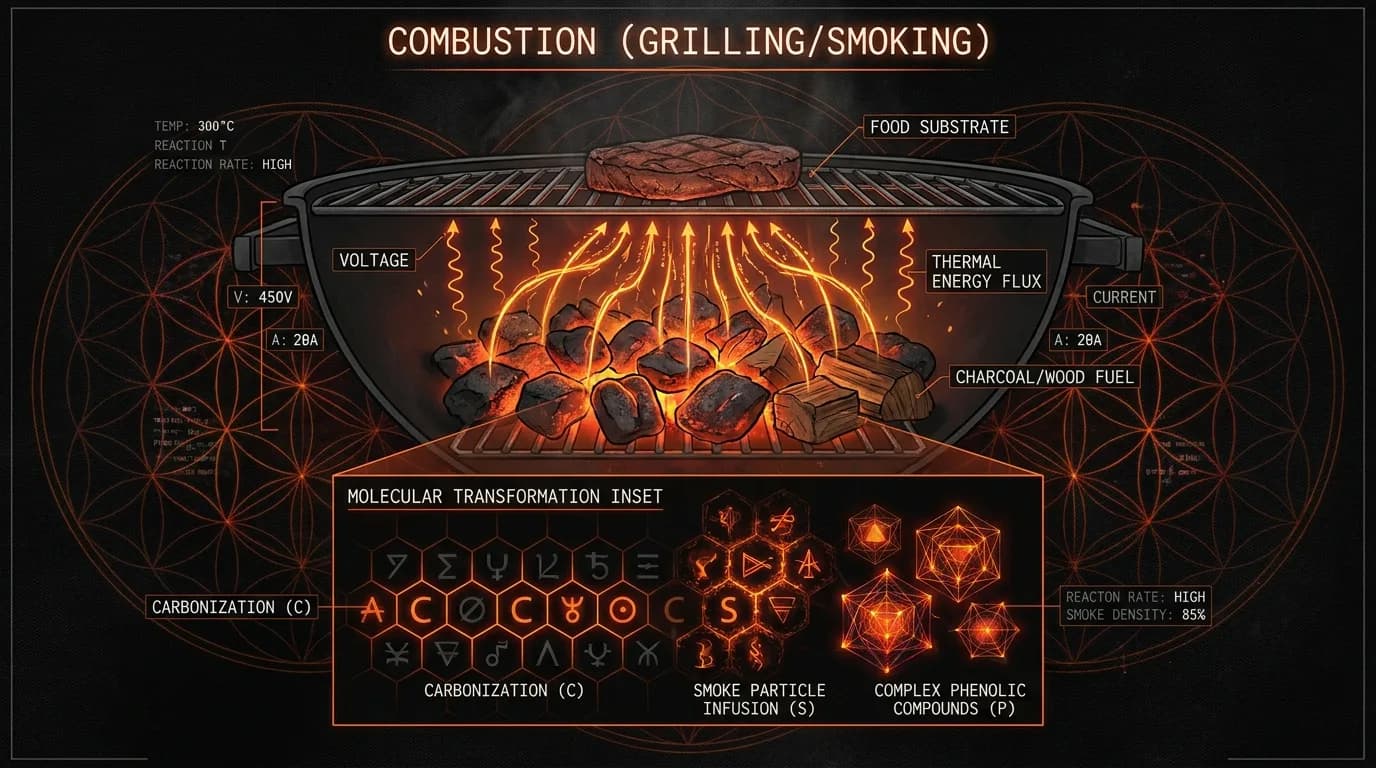
PYROLYTIC_TRANSMUTATION
grilling
The Pyrolytic Transmutation
Intense thermal energy transfer from live ember to exposed substrate. Surface carbonization proceeds beneath a high-density smoke particle current, formulating complex phenolic compounds through pyrolysis.
KINETIC_PROFILE
High-voltage thermal energy (V) interacting with a high-density smoke particle current (I).
Q = mcΔT + Smoke_Infusion_RateELEMENTAL_SIGNATURE
This transmutation leans fire.
ASTROLOGICAL_RULERSHIP
Orbital alignment dictates aggressive thermal application tempered by expansive smoke exposure.
MOLECULAR_INTERACTION
Carbonization
Maillard reaction acceleration yielding melanoidin structures across the contact surface.
Phenolic Binding
Guaiacol and syringol deposition altering flavor profile matrices at the surface layer.
C6H5OH → C7H8O2THERMAL_ENVELOPE
Direct radiant heat from flame/coals for fast char and crust formation.
PRAXIS
BENEFITS
- imparts smoky flavor
- creates appealing char marks
- renders fat
- quick cooking
- caramelizes exterior
- develops umami
SUITABLE_SUBSTRATES
INSTRUMENTS
- Grill (gas, charcoal, or wood-fired)
- Long-handled tongs or spatula
- Grill brush
- Meat thermometer
- Basting brush
COMMON_FAILURES
- too high heat
- constant flipping
- pressing down on food
- improper grill temperature zones
- not preheating properly
- lid misuse
REGIONAL_VARIANTS
- ARGENTINE asado, parrilla technique
- KOREAN bulgogi, galbi
- AMERICAN barbecue, Santa Maria-style
- JAPANESE yakitori, robatayaki
- MIDDLE EASTERN kebab, meshwi
OPTIMAL_TEMPERATURES
SAFETY_SIGILS
- Proper fire management
- Food temperature monitoring
- Proper tool use
- Avoid cross-contamination
- Fire extinguisher nearby
ARCHIVES
HISTORICAL_RECORD
Grilling is among humanity oldest cooking methods, dating back to the discovery of fire around 1.8 million years ago. Every culture has developed variation of cooking over direct flame, from the South American asado to the Japanese yakitori, making it a universally significant culinary technique.
SCIENTIFIC_PRINCIPLES
- Radiant heat transfer directly from flame/coals to food
- Maillard reaction creates hundreds of flavor compounds at 300°F-500°F
- Caramelization of sugars at high temperatures
- Smoke particles adhere to food surface adding flavor compounds
- Fat dripping causes flare-ups that add char and smoky notes
- Direct heat creates temperature gradient from exterior to interior