LIPID_IMMERSION
frying
The Lipid Crucible
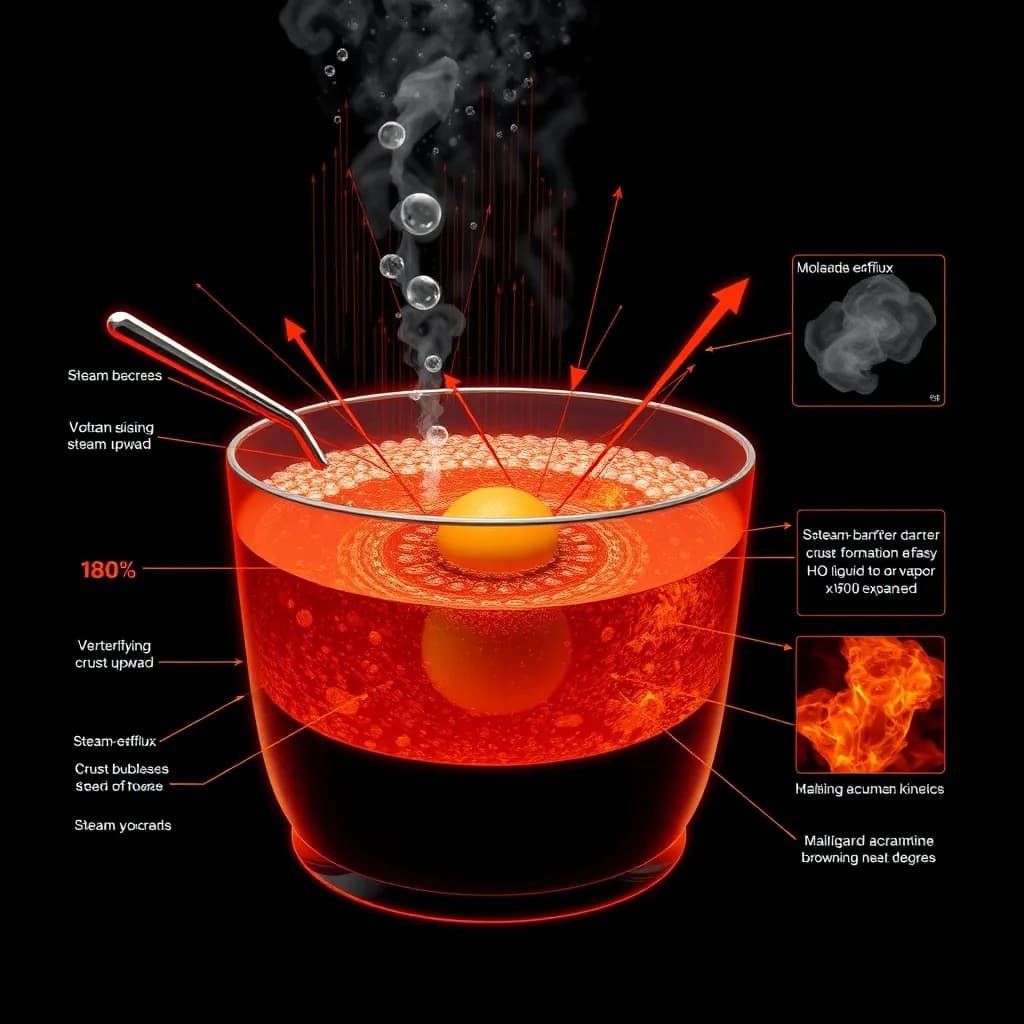
Total submersion in a superheated lipid medium. Oil floods every exposed surface simultaneously as a dielectric heat-transfer fluid, while violent steam efflux holds the crucible at bay and forges the crust.
KINETIC_PROFILE
The bath applies high voltage uniformly from all sides; convective current density in oil dwarfs air-based transfer. Outbound steam runs as a counter-current, throttling oil ingress while the crust resistor forms.
q = h·A·(T_oil − T_s)Newton's law of cooling — the convective coefficient h of hot oil exceeds that of air by an order of magnitude.
k = A·e^(−Ea/RT)Arrhenius — Maillard and acrylamide formation rates climb exponentially with bath temperature.
ELEMENTAL_SIGNATURE
This transmutation leans fire.
ASTROLOGICAL_RULERSHIP
MOLECULAR_INTERACTION
Steam-Barrier Crust Formation
Surface water flashes to vapor on immersion, and the outward steam flux repels oil ingress. A dehydration front recedes into the substrate; once surface moisture collapses, starches and proteins vitrify into the glassy crust.
H2O(l) → H2O(g)Maillard / Acrylamide Kinetics
Arrhenius-governed browning accelerates across the dehydrated face. Asparagine condenses with reducing sugars along the acrylamide pathway, trading color and aroma against thermal overexposure.
Lipid Oxidation & Polymerization
The medium itself transmutes under sustained thermal stress. Triacylglycerols cleave into free fatty acids and volatile aldehydes, then polymerize — each service cycle lowers the smoke point of the crucible.
THERMAL_ENVELOPE
Oil-mediated heat transfer; crispness and Maillard usually optimized in this zone.
PRAXIS
BENEFITS
- quick cooking
- crispy texture
- flavor development
- heat distribution
- sensory appeal
- caramelization
- maillard reaction intensification
- moisture retention inside food
SUITABLE_SUBSTRATES
INSTRUMENTS
- Deep fryer or deep pan
- Thermometer (oil/candy)
- Spider strainer or slotted spoon
- Paper towels or wire rack
- Heat-resistant gloves
- Fire extinguisher
- Timer
- Long tongs
- Oil filter (for reusing oil)
- Temperature-controlled fryer
COMMON_FAILURES
- oil temperature too low (causes greasiness)
- oil temperature too high (causes burning)
- overcrowding the fryer (lowers oil temperature)
- improper draining (causes sogginess)
- not maintaining oil temperature between batches
- using wrong oil type (wrong smoke point)
- improper breading technique (causes coating to fall off)
- neglecting to season immediately after frying
EXPERT_DIRECTIVES
- Use fine table salt for immediate post-fry seasoning (adheres better than coarse salt)
- For extra-crispy batter, add a small amount (1 tsp per cup) of rice flour or cornstarch
- Double-bread items with a rest period between coatings for thicker, more substantial crust
- Add a small amount of baking powder to dry coatings for increased bubbling and surface area
- For extremely crisp results, replace 10-20% of water in batter with vodka (evaporates faster)
- When deep-frying large batches, maintain oil temperature with small additions between batches
- Use carbonated liquid (beer, seltzer) in batter to create additional bubbles and lightness
- Never cover freshly fried foods, steam condenses and destroys crispness
REGIONAL_VARIANTS
- JAPANESE tempura (light, airy batter), karaage (double-fried chicken), korokke (potato croquettes)
- SOUTHERN US deep-fried chicken, hushpuppies, chicken-fried steak, corn fritters
- INDIAN pakora (vegetable fritters), samosa (filled pastry), bhajji (spiced fritters), puri (fried bread)
- MEXICAN churros (ridged dough pastry), chiles rellenos (stuffed peppers), flautas (rolled tacos), sopapillas (fried dough)
- MIDDLE EASTERN falafel (chickpea fritters), kibbeh (meat and bulgur croquettes), sambousek (filled pastries)
OPTIMAL_TEMPERATURES
SAFETY_SIGILS
- Use oils with high smoke points (peanut, sunflower, canola, rice bran)
- Keep water away from hot oil to prevent dangerous splattering
- Monitor oil temperature constantly with thermometer
- Keep fire extinguisher (Class K) nearby, never use water on oil fires
- Never leave hot oil unattended
- Allow sufficient headspace in fryer (oil expands and bubbles)
ARCHIVES
HISTORICAL_RECORD
Frying dates back to ancient Egypt around 2500 BCE, with evidence of oil-cooking vessels and depictions in tomb paintings. The technique spread throughout the Mediterranean and was later refined in Asia and Europe. Deep-frying became especially popular during medieval times in Europe, while tempura was introduced to Japan by Portuguese traders in the 16th century. Modern industrialization in the 20th century, particularly the rise of fast-food chains, has made fried foods a global phenomenon. Throughout the centuries, different cultures developed unique approaches—from the light tempura batters of Japan to the seasoned cornmeal coatings of Southern American cuisine. In the late 20th and early 21st centuries, technological innovations like vacuum fryers, pressure fryers, and air fryers have attempted to address health concerns while maintaining the appealing characteristics of traditional frying.
SCIENTIFIC_PRINCIPLES
- Conduction transfers heat from oil to food surface rapidly and efficiently
- Steam barrier forms between food and oil, creating bubble shield
- Maillard reaction creates hundreds of flavor compounds at high temperatures
- Dehydration of surface creates crispy texture through structural changes
- Vapor pressure inside food prevents oil penetration into the center
- Oil serves as efficient heat transfer medium (better than air or water)
- Surface temperature reaches 300-400°F while interior cooks at 212°F maximum
- Protein denaturation and starch gelatinization occur simultaneously