BROAD_CONDUCTION_FOUNDRY
Tilt Skillet
The Foundry Plate
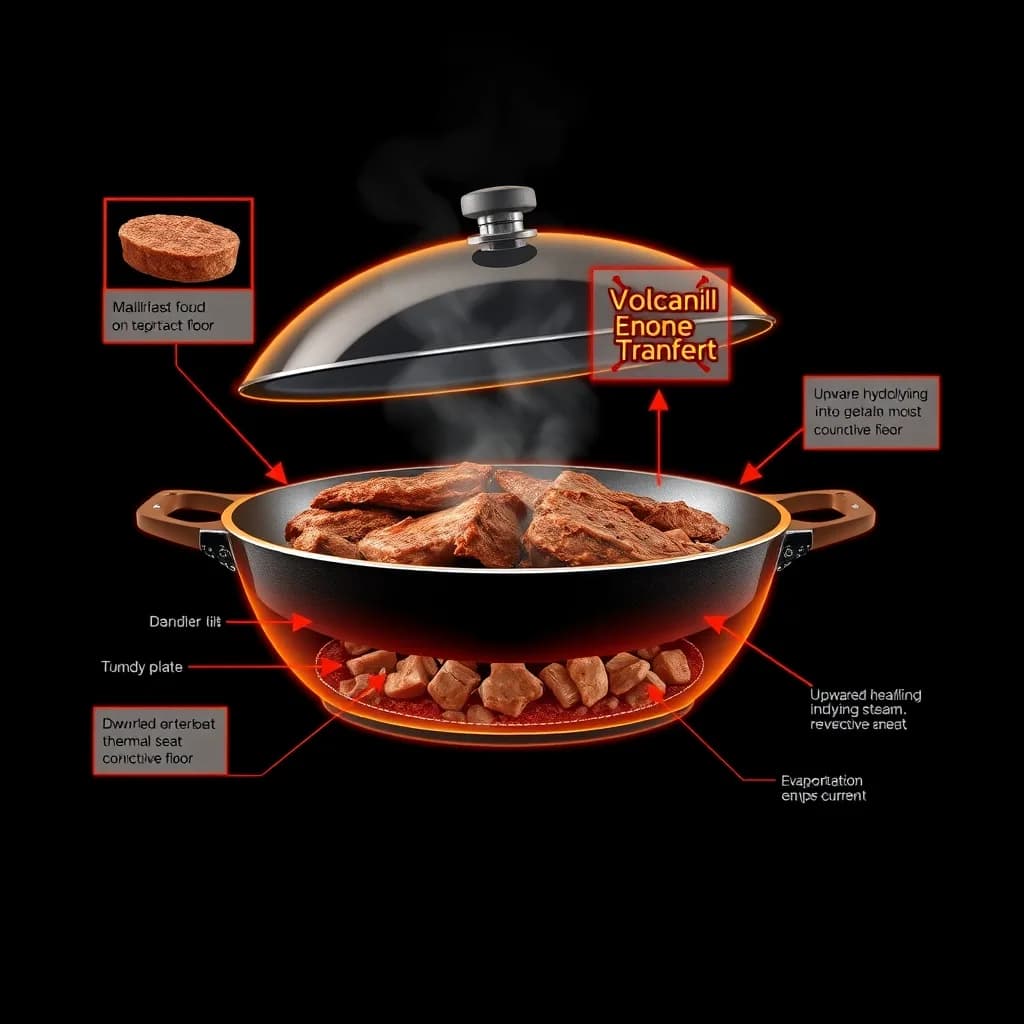
A wide steel floor delivers a sustained conductive sear across an entire batch, then the lid drops and the plate pivots into a covered braise — one vessel cycling from dry foundry heat to moist convective transmutation.
KINETIC_PROFILE
A high contact voltage (V) is spread as a distributed current (I) across the full floor — broad rather than wok-extreme, but sustained by a large thermal mass. On the tilt, the lid converts dry conduction into moist convection: Fire recedes, Water rises, and collagen yields to gelatin.
q = −k∇T (sear) → q = h·A·(T_liq − T_s) (braise)Fourier conduction during the sear gives way to Newtonian convective transfer once liquid and lid are introduced.
C_th = m·c (large)The heavy steel floor stores enough energy to hold temperature when a full batch is loaded.
ELEMENTAL_SIGNATURE
This transmutation leans fire.
ASTROLOGICAL_RULERSHIP
Martian sear opened, then handed to Saturnine patience — aggression set down into the long, structured braise.
MOLECULAR_INTERACTION
Fond Development
Maillard browning on the broad contact floor lays down a fond of caramelized proteins and sugars that later dissolves into the braising liquid as the flavor backbone of the batch.
Collagen → Gelatin
Under the lid's moist convective heat, tough collagen hydrolyzes into gelatin over time, transmuting structure into silky body across the whole batch.
collagen + H2O → gelatin70°C – 95°CReduction & Concentration
Tilting opens the plate to evaporation; the braising liquid concentrates as water leaves, intensifying the dissolved fond into a glaze.
THERMAL_ENVELOPE
Broad steel floor seared at the high end, then dropped to ~300°F for the covered braise phase.
PRAXIS
BENEFITS
- high-volume throughput
- dual sear-then-braise in one vessel
- even flat-top heat distribution
- fond development for deep sauces
- batch-to-batch consistency
- controlled liquid reduction at scale
SUITABLE_SUBSTRATES
INSTRUMENTS
- Tilting braising pan / tilt skillet
- Long-handled flat spatula or paddle
- High-BTU burner or built-in element
- Lid for the braise phase
- Staging pans for sequential batches
- Probe thermometer
COMMON_FAILURES
- overcrowding the floor (steaming instead of searing)
- searing too large a batch at once instead of in waves
- deglazing before the fond has developed
- adding braising liquid while still in sear mode
- uneven ingredient sizing across a big batch
REGIONAL_VARIANTS
- INSTITUTIONAL batch braising for cafeterias, banquet-scale sear-and-hold
- FRENCH braisé à la plaque, large-format daube
- AMERICAN diner flat-top batch service, chili and stew lines
OPTIMAL_TEMPERATURES
SAFETY_SIGILS
- Lock the tilt mechanism before loading
- Pour off hot liquid away from the body
- Mind steam release when lifting the lid
- Keep the broad floor evenly loaded to avoid hot spots
- Use long heat-resistant gloves for the large surface
ARCHIVES
HISTORICAL_RECORD
The tilting skillet (tilting braising pan) emerged in mid-20th-century institutional kitchens as a single vessel that could sear, fry, braise, and pour off at scale, replacing several specialized pieces. Its broad, shallow, tilting body made high-volume sear-then-braise cooking practical for cafeterias, banquets, and production lines.
SCIENTIFIC_PRINCIPLES
- A broad flat steel floor maximizes conductive contact area for an even sear
- Large thermal mass buffers temperature drops when a full batch is loaded
- Sequential staging matches each ingredient's cook time within one vessel
- Maillard browning in the sear phase builds fond that flavors the later braise
- The lid traps vapor to shift from dry conduction to moist convective braising
- Tilting enables controlled reduction and clean pour-off of large liquid volumes